


From Westside’s integrated fashion platform to Zudio’s mass-market engine, Trent has built a portfolio that tests, scales and reshapes the economics of fashion retail…
What began as an experiment to take Trent’s fashion capabilities beyond Westside has evolved into a 1,000-store value-fashion phenomenon — and potentially its most replicable retail model.
Trent’s fashion story today is considerably bigger than Zudio. Its portfolio spans more than 1,300 large-format fashion stores, with Westside, Zudio and other lifestyle concepts addressing different consumer segments, price points and occasions. Yet Zudio’s journey is extraordinary in its own right: from its first store on Bengaluru’s Commercial Street in September 2016, it has crossed 1,000 stores, 300+ cities and 100m+ customers in a decade. The more interesting question is not simply how quickly Zudio expanded, but what Trent built underneath its brands that made such expansion possible.
The answer lies in a fashion-retail model that combines private-label control, merchandising, sourcing, price architecture, store design and direct customer relationships. Rather than primarily providing a platform for third-party brands, Trent creates and controls the proposition across its principal fashion formats. The result is a portfolio in which each concept has a different consumer promise, price point and physical expression, while sharing a common advantage: greater control over product, margin, inventory and customer experience.
Westside was the laboratory
Zudio did not emerge from a blank sheet of paper. Trent had already spent years developing Westside into an integrated fashion-and-lifestyle business, with 22+ in-house labels spanning women, men, kids, footwear, lingerie, cosmetics, perfumes, accessories and home. Its capabilities extend across design, production, supply chain, stores and customers, giving the business control over much of the journey from product conception to the final retail experience.
Westside therefore established the capabilities that would later become crucial to Zudio: understanding fashion, creating own brands, merchandising across categories, sourcing at scale, managing inventory, designing stores and controlling the customer proposition. But the two formats apply those capabilities very differently. Westside is an aspirational lifestyle proposition; Zudio is the radical simplification of that proposition for a much larger value-conscious market.
That distinction matters. Zudio was not simply “cheaper Westside”. It changed four variables simultaneously—price, fashion, geography and shopping experience. Trent’s disclosures describe Zudio around accessibility, exclusive in-house merchandise, sharp pricing, constant refreshes, shorter lead times and prominent stores, while noting important similarities with Westside’s underlying operating capabilities.
A portfolio built around control
The most important part of Trent’s fashion story may be what happens before merchandise reaches the shop floor. Across its principal fashion concepts, the company’s private-label orientation gives it far greater control over what is designed, sourced, priced and presented to the customer than a conventional multi-brand retailer.
Westside operates at the aspirational end with a 100% private-label proposition and structured sub-brands such as Nuon, ETA and Bombay Paisley. Its centralized design capabilities allow Trent to coordinate merchandise and supply-chain decisions, while the format uses a mid-to-premium pricing architecture, with average ticket sizes of roughly ₹2,000–₹4,000 and relatively limited reliance on discount-led selling.
At the other end, Zudio takes the same principle of control and pushes it into value fashion. Its merchandise is built around a rapid 12-day supply loop, with orders routed directly to manufacturing clusters such as Tirupur and Ludhiana, reducing intermediary layers and distribution costs. The proposition is deliberately capped at below ₹999, with selected essentials and cosmetics beginning at ₹99 and ₹149, creating a low-risk environment for impulse fashion purchases.
Utsa occupies the contemporary Indian space, with merchandise broadly positioned between ₹999 and ₹2,999, while increasingly drawing on Westside’s broader apparel engine. Misbu works at the beauty-and-accessories end, with a high-churn proposition and price points focused below ₹299 and ₹499. Samoh deliberately moves in the opposite direction, offering elevated occasion wear at approximately ₹5,000–₹25,000+, supported by more artisanal sourcing and premium fabrics.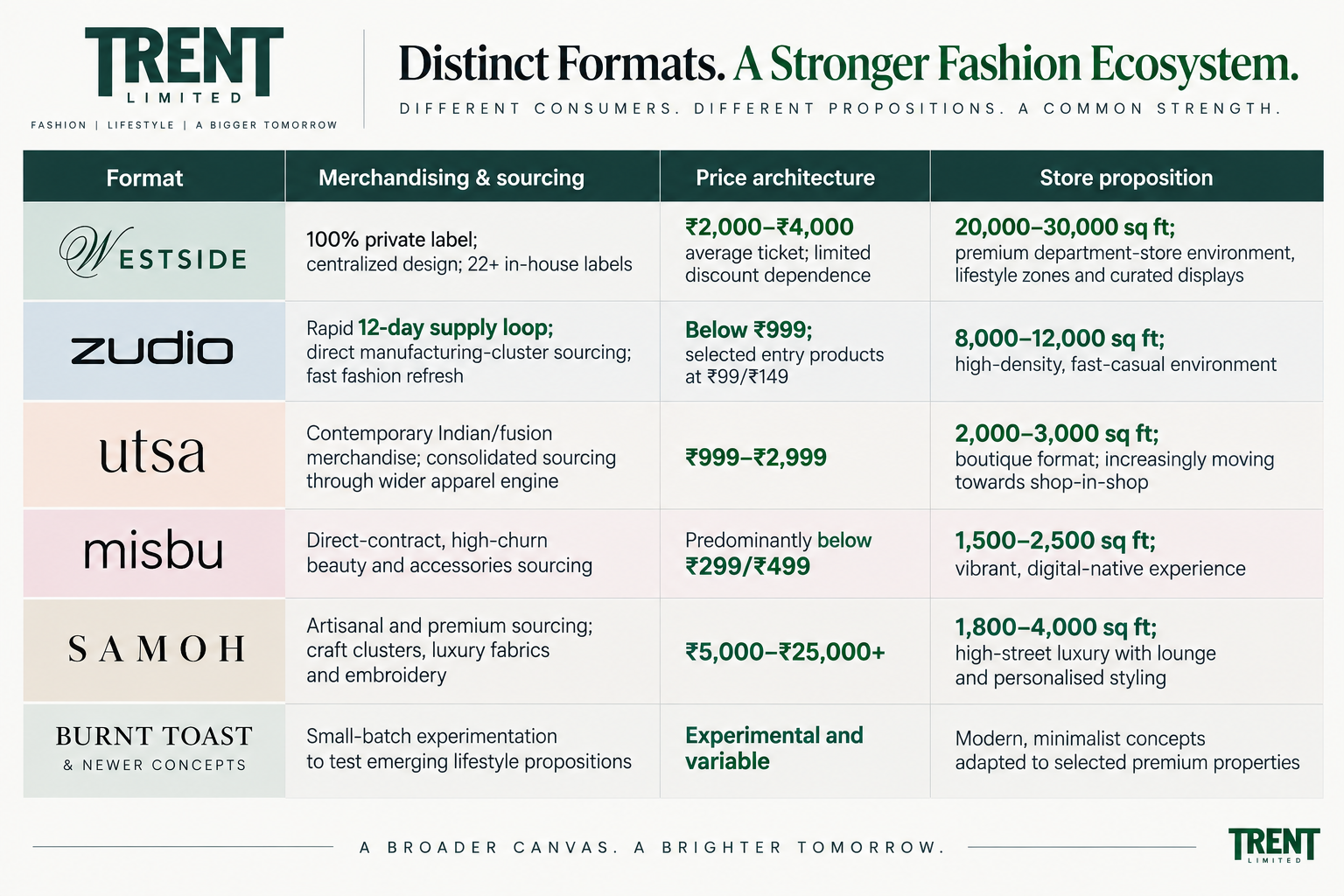
The differentiation, therefore, is not simply brand versus brand. It is business model versus business model. A conventional department store can curate an attractive assortment, but the brands supplying it ultimately control much of the product, pricing and supply-chain economics. Trent’s private-label orientation allows it to engineer the proposition from the product backwards.
That control also gives Trent something particularly valuable in fashion: the ability to calibrate product, price, inventory and store experience as one system.
The inverse real-estate equation
The portfolio becomes even more revealing when these formats are viewed together. Westside occupies the broadest lifestyle canvas, with larger stores, higher average tickets and a more curated department-store experience. Zudio compresses footprint, price and presentation to maximise fashion discovery and volume. Misbu goes smaller and younger, using beauty and accessories to encourage frequent, lower-value purchases. Utsa addresses contemporary Indian fashion, while Samoh deliberately moves towards elevated occasion wear.
There is an inverse real-estate equation at work: as the proposition moves from Westside towards younger, more value-oriented concepts, store sizes and architectural complexity generally shrink while merchandise density and transaction frequency become more important. Trent is matching real estate, merchandise, price and customer behaviour to each format rather than attempting to impose one store model across the portfolio.
That is a significant competitive distinction. The store is not simply a container for merchandise; the merchandise, price and physical environment are designed as one proposition.
Zudio changed the velocity of the equation
Within this architecture, Zudio has emerged as the breakthrough. Its merchandising model is built around fashion velocity rather than traditional seasonal dependence. The rapid supply loop, direct routing to manufacturing clusters and predominantly India-based sourcing give Trent the flexibility to respond quickly to trends while keeping the merchandise proposition fresh.
Sourcing almost entirely within India is a strategic choice rather than simply a cost decision. Trent has highlighted access, speed and flexibility as important advantages, allowing the business to refresh collections frequently and reduce lead times. Strong inventory management, warehouse infrastructure and technology support the flow of new merchandise through the network.
Pricing is the other half of the equation. With inventory positioned below ₹999 and selected products entering at ₹99 and ₹149, Zudio lowers the psychological barrier to experimentation. A consumer does not need to make a considered high-ticket fashion purchase; the proposition encourages multiple, relatively low-risk discoveries.
Fashion becomes less an occasional purchase and more an accessible, repeatable shopping habit.
The store completes the loop. At 8,000–12,000 sq ft, Zudio is substantially smaller than Westside but dense enough to present a broad fashion assortment. Its stripped-back environment, high merchandise density and fast-casual layout are not merely aesthetic choices; they are part of the economic model, allowing Trent to maximise merchandise visibility and shopper throughput without building an expensive premium environment.
This is where merchandising, sourcing, pricing and real estate converge. The store is not a container for the merchandise; it is part of the merchandise proposition.
The store network became the proof
The store trajectory captures the transformation: 80 stores in FY20, 133 in FY21, 233 in FY22, 352 in FY23, 545 in FY24, 765 in FY25 and 963 in FY26, followed by 982 stores at June 30, 2026, including seven in the UAE, before crossing 1,000 in September.
The significance of that progression is greater than the headline number. The first phase established consumer acceptance; the subsequent hundreds of stores demonstrated that the format could be reproduced across very different micro-markets without fundamentally changing its operating architecture.
Opening the first 100 stores proves that a concept works. Opening nearly 1,000 proves that the operating system works.
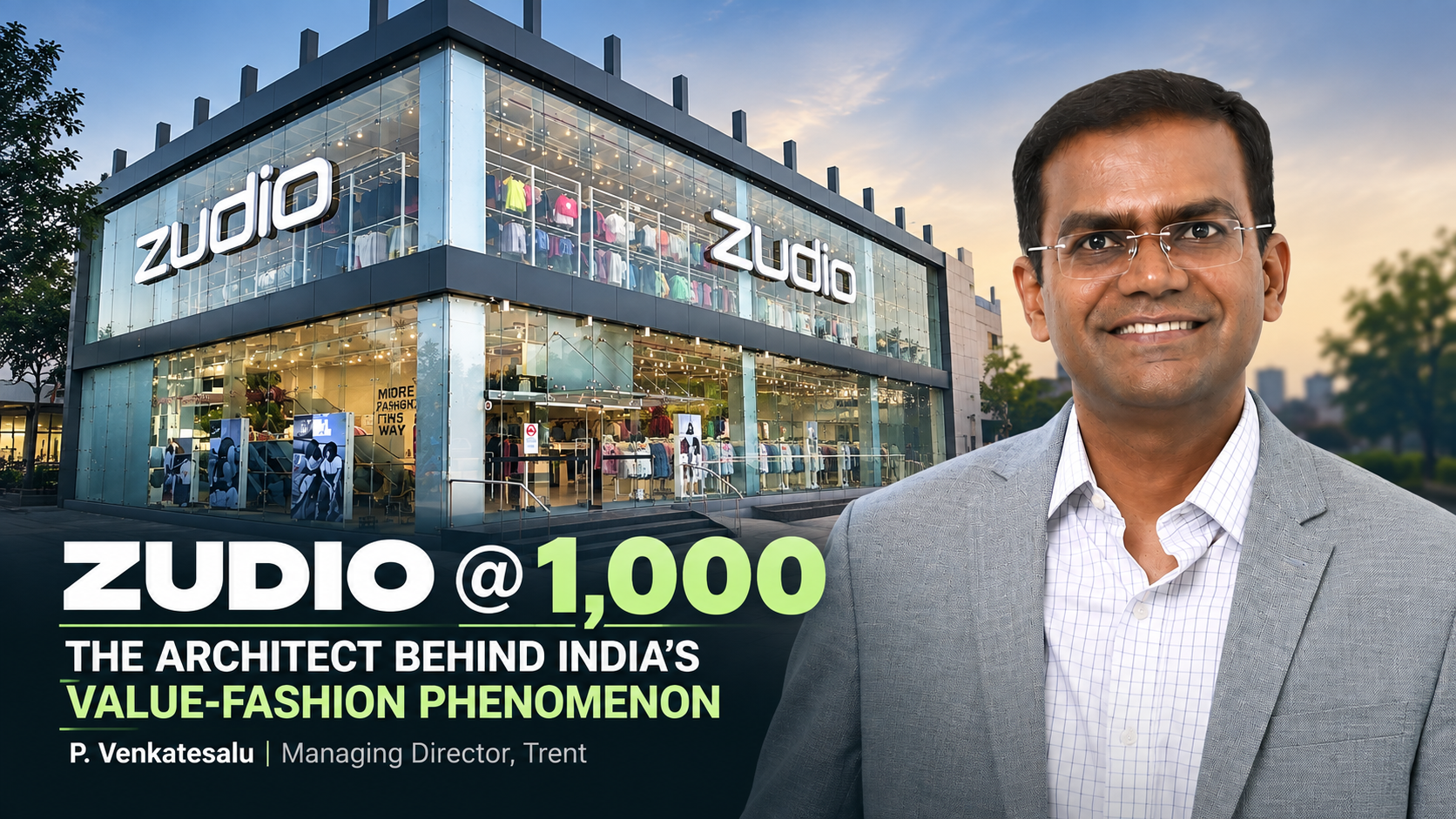 P. Venkatesalu’s tenure fits naturally into this period of extraordinary scaling. But the phenomenon is larger than any one executive: the defining achievement has been Trent’s ability to institutionalise the capabilities behind the formats and deploy them repeatedly across markets.
The map became part of the fashion proposition
Scale would mean much less if Zudio were simply replicating the same metropolitan proposition. Instead, geography has become integral to the model. In FY26, Zudio added 208 domestic stores and entered 76 cities, while more than 80% of new stores were in Tier II/III cities and peripheral new-growth micro-markets. The same more-than-80% proportion continued in Q1 FY27. Trent expects newer markets to take around two to three years to mature, making market density and future consumption as important as immediate store productivity.
This is where the fashion proposition becomes particularly powerful. Zudio is not merely taking low prices to smaller cities; it is taking current fashion, newness and organised retail experience to markets where those choices were historically less accessible.
The biggest change Zudio made to Indian fashion may not have happened on the rack. It happened on the map.
The financial engine is getting stronger
Zudio is not disclosed as a clean standalone revenue line in Trent’s current reporting, so attributing Trent’s entire standalone revenue to Zudio would be incorrect. The relevant financial picture is the performance of Trent’s standalone business, increasingly powered by its fashion and lifestyle operations.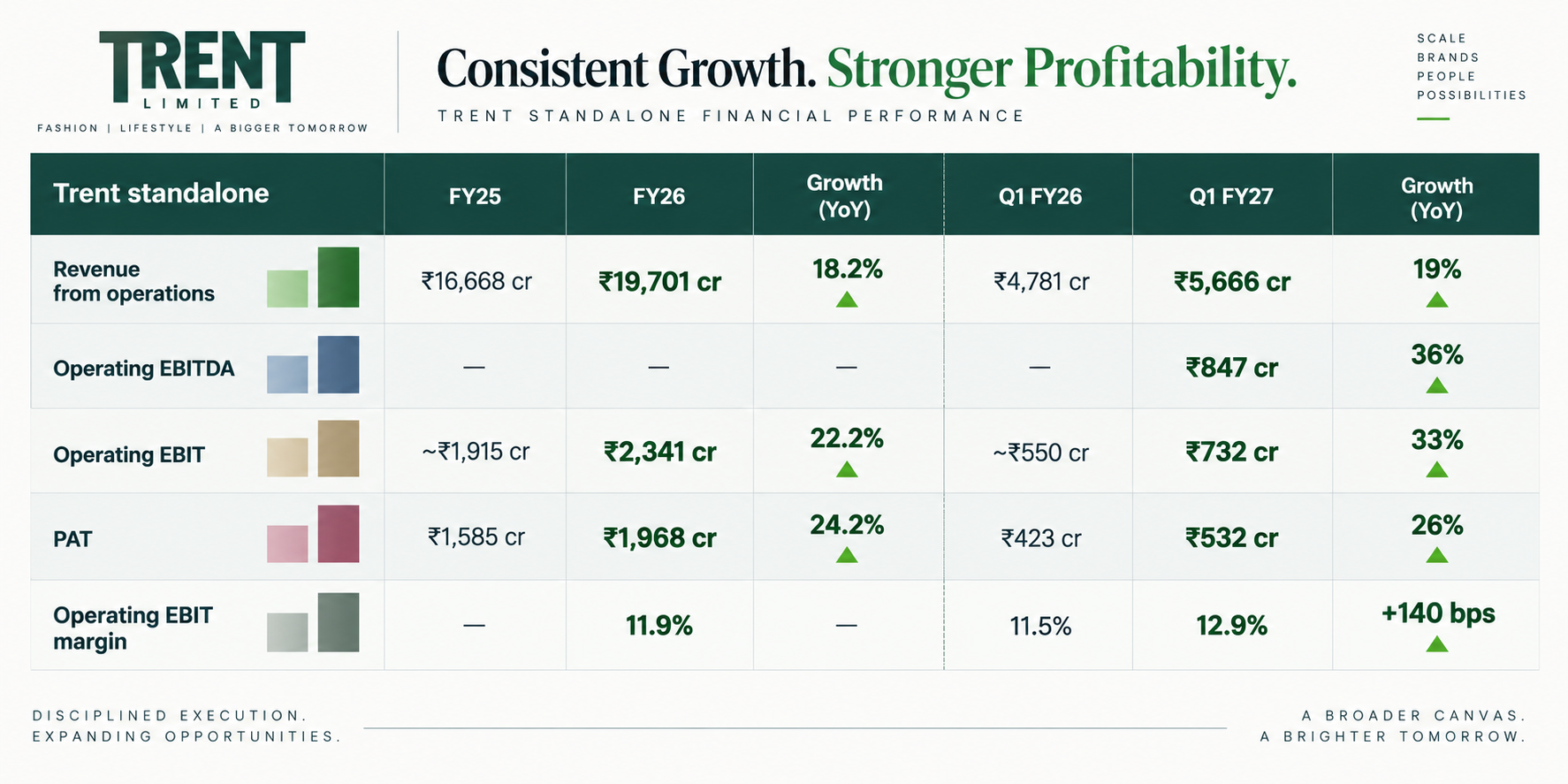
The pattern is important: FY26 revenue grew 18.2%, EBIT 22.2% and PAT 24.2%; in Q1 FY27, revenue grew 19%, while EBITDA and EBIT grew 36% and 33%. Operating EBIT margin expanded from 11.5% to 12.9% in the quarter, indicating increasing operating leverage as the network scales.
The broader fashion portfolio is also becoming more productive and diversified. In Q1 FY27, beauty and personal care, innerwear and footwear contributed more than 21% of fashion-portfolio revenues, while Westside’s online business through Westside.com and Tata Neu exceeded 6% of Westside revenue and was growing profitably.
The implication is significant: Trent’s fashion opportunity is no longer only about adding apparel stores. It is expanding across categories, channels and consumer occasions while retaining a common emphasis on own brands, product responsiveness, efficiency and convenience.
UAE is the portability test
Zudio’s expansion into the UAE introduces a different question. India has been the market in which Trent has tested affordability, fashion accessibility and geographic expansion; the UAE is testing whether the underlying proposition itself can travel.
The first overseas Zudio store opened in Dubai in 2024, and the network has since reached seven UAE stores. The Middle East is also a different consumer environment from the Tier II and III markets that have driven much of Zudio’s Indian expansion, exposing the format to consumers who are already familiar with international fast-fashion propositions.
That makes the UAE less an ordinary overseas expansion and more a controlled laboratory. India represents the democratisation of fashion; the UAE represents the internationalisation of the formula.
The question is whether the combination of value, fashion, newness, accessibility and physical discovery that resonated so strongly in India can appeal to consumers in a much more internationally exposed market.
Beyond Zudio: the portfolio is the strategy
It would be easy to look at Trent’s fashion business as a collection of brands and Zudio as its runaway success. A better interpretation is that Trent has built a portfolio of fashion propositions supported by a common capability base, but with deliberately different merchandising, sourcing, pricing and store economics.
Westside established the integrated fashion platform. Zudio took that platform to the mass market by radically increasing accessibility and velocity. Utsa addresses contemporary Indian fashion, Misbu explores beauty and accessories, Samoh occupies the elevated occasion-wear space, while Burnt Toast and newer concepts provide a continuing test bed for emerging lifestyle opportunities.
This also explains why every concept does not need to become a Zudio-sized chain. Trent can test a proposition, observe its economics, scale where the model demonstrates repeatability and rationalise or integrate concepts where the standalone economics are less compelling. The portfolio itself becomes a capital-allocation mechanism.
That is ultimately the bigger Trent story.
The company has not simply found one winning fashion brand. It has developed a mechanism for building, testing and scaling fashion propositions—and Zudio is the clearest proof that the mechanism works.
Westside taught Trent how to build fashion. Zudio taught it how to scale fashion.
The first 1,000 Zudios are therefore not simply the end of an extraordinary store-expansion story. They mark the point at which Trent’s accumulated capabilities in merchandising, sourcing, pricing, private-label control, real estate and customer experience have been demonstrated at mass-market scale.
The next chapter will be about whether Trent can use that operating discipline to create the next generation of fashion and lifestyle winners—and whether the Zudio formula itself can travel beyond India.