




Myntra’s next chapter begins as Sharon Pais inherits a platform that has moved beyond commerce to shape fashion demand across India.
In today’s fashion landscape, platforms don’t just sell—they compete for attention, relevance, and cultural currency. For Myntra, the challenge is no longer about bringing fashion online. It is about staying at the centre of a fast-moving, hyper-competitive ecosystem where consumers are constantly navigating between marketplaces, brand-owned apps, global fast-fashion platforms, and social commerce.
And yet, Myntra continues to hold its ground—not merely as a scale player, but as a fashion-first destination that blends commerce with content, culture, and community.
The numbers reflect both scale and maturity. Myntra has crossed ₹6,000+ crore in FY25 revenue and is trending towards ₹7,200+ crore in FY26, with profitability strengthening sharply. It now engages ~200 million annual active users, peaks at ~80 million monthly active users during high-traffic periods, serves 19,000+ pincodes, and hosts 9,700+ brands, offering over 4 million styles.
But what has kept it ahead is not just infrastructure—it is its ability to continuously reinterpret fashion for a new generation of consumers, across segments, price points, and cultural contexts.
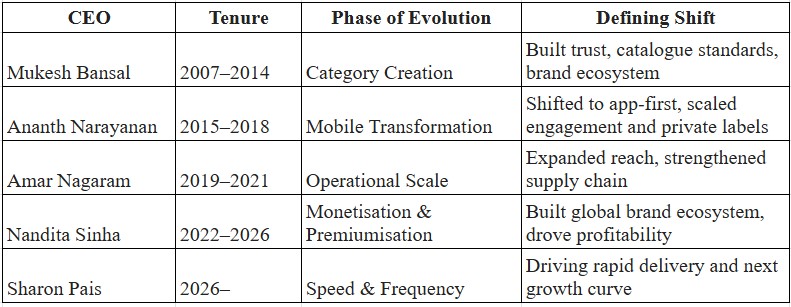
The Leadership Behind the Evolution
 From Transaction Platform to Fashion Authority
Myntra’s evolution mirrors the maturation of India’s fashion consumer. What began as a transactional marketplace has steadily moved toward becoming a fashion authority—shaping not just purchases, but preferences.
This transformation has been driven as much by marketing and storytelling as by supply chain and assortment.
Campaigns such as End of Reason Sale (EORS) have evolved into cultural moments in India’s retail calendar, consistently drawing ~20 million users during peak editions and adding over 1.3 million new customers. These events function as large-scale demand engines, combining celebrity partnerships, creator ecosystems, and high-frequency digital engagement.
Myntra’s integration of influencers and creators through Myntra Studio reflects a deeper shift—fashion discovery is no longer search-led but content-led, where trends are consumed, validated, and acted upon in real time.
Across platforms, Myntra has positioned itself not just as a retailer, but as a participant in fashion conversations, particularly among Gen Z—who now account for ~50% of its customer base.
Competing in an Age of Infinite Choice
The competitive landscape today is far more fragmented than when Myntra began. Consumers are no longer loyal to platforms—they move fluidly between:
- Brand-owned D2C sites
- Global fast-fashion apps
- Horizontal marketplaces
- Social commerce ecosystems
In this environment, Myntra’s strength lies in its ability to combine scale, curation, and engagement within a single platform.
Its reach across 19,000+ pincodes ensures availability, while its portfolio of 9,700+ brands offers unmatched depth. But the real differentiation lies in how fashion is presented—through curated storefronts, trend-led merchandising, and increasingly, AI-driven personalisation and size-fit intelligence.
At the same time, Myntra has built a strong position in the mid-premium segment, capturing India’s fast-expanding aspirational consumer base—positioned between value marketplaces and luxury platforms.
Global Brands, Local Demand
Myntra’s role as a gateway for international brands has strengthened significantly.
The platform now hosts 450+ global brands, adding 40+ new international labels in 2025 alone, including NEXT, Bershka, GAP, DKNY, The North Face, Love Moschino, and Ben Sherman, alongside beauty brands such as The Ordinary, Sulwhasoo, and Beauty of Joseon.
What stands out is the geographic spread of demand. Nearly 45% of international brand consumption now comes from Tier-2 and Tier-3 markets, with cities like Jaipur, Lucknow, Indore, and Guwahati emerging as key demand centres.
This reflects a deeper shift—premium aspiration is no longer metro-led.
Myntra’s logistics innovations have enabled this transition. Through M-Express, nearly 50% of international brand orders are delivered within 48 hours, while M-Now enables near-instant delivery in key markets, with 50+ global brands already integrated into the service.
In effect, Myntra has become a distribution and demand-generation platform for global fashion in India, compressing the time between global trends and local consumption.
Fashion Segmentation: From Value to Luxe
Myntra’s growth strategy is increasingly defined by segmentation.
At one end, it continues to serve value-conscious consumers through scale brands and private labels. At the core lies the mid-premium segment, where aspiration meets accessibility—driving a significant share of growth.
At the upper end, Myntra is building a presence in bridge-to-luxury and emerging luxury segments, through curated propositions and premium brand partnerships.
This layered architecture allows Myntra to operate across the full spectrum of fashion consumption—from affordability to aspiration to premium expression—without diluting its positioning.
Beyond Apparel: Building a Lifestyle Platform
Myntra’s expansion into beauty and adjacent categories reflects a broader shift—from fashion retail to lifestyle platform.
Beauty has emerged as a key growth driver, expanding at 2.5x the pace of the online luxe beauty market, with K-beauty alone witnessing ~200% growth. The category brings higher purchase frequency, complementing fashion’s seasonal nature.
At the same time, Myntra is building depth in occasion wear, premium gifting, and niche fashion segments, enabling higher-value transactions and deeper consumer engagement.
Speed, Culture, and the Next Phase
With Sharon Pais taking over, Myntra’s next phase is being shaped by speed and frequency.
M-Now already contributes ~10% of orders in active markets, operates through 80+ dark stores, covers 940+ pincodes, and has attracted 35 million+ visitors. With deliveries as fast as 10 minutes, it introduces impulse-led fashion consumption, compressing the gap between inspiration and ownership.
At the same time, social commerce already contributes 10%+ of Myntra’s revenue, with ambitions to scale further through a growing creator ecosystem.
Backed by Walmart’s long-term vision for Flipkart—focused on profitability, scale, and IPO readiness—Myntra is positioned as a strategic growth engine within India’s consumer internet landscape.
Fashion, Reimagined
Myntra’s evolution reflects a broader shift in Indian fashion—from access to aspiration, and now toward immediacy.
It has built a platform that:
- Shapes demand across segments
- Enables global brands to scale in India
- Integrates content, commerce, and convenience
As fashion cycles shorten and consumer expectations rise, the next phase will depend on how effectively Myntra can convert engagement into habitual consumption.
Because in today’s fashion economy, leadership is no longer defined by scale alone—but by the ability to stay culturally relevant while moving at speed.