





The Hyderabad-born footwear brand marks its 50-store milestone as it looks to build a 500-store national network and scale revenue from Rs 185 crore to Rs 1,000 crore…
For Neeman’s, the opening of its 50th store is less about counting outlets and more about measuring how far an idea has travelled. The Hyderabad-born footwear brand began in 2018 with a simple belief articulated by founder and CEO Taran Chhabra: “shoes should feel as good as they look.” Seven years later, that proposition has evolved into a physical retail network spanning 50 stores across 16 states and 31 cities, with the company now setting its sights on 500 stores across India and a ₹1,000-crore business.
The 50th store, located in Punjagutta, Hyderabad, occupies 2,437 sq. ft. and carries a particular significance for the brand because Hyderabad is where the Neeman’s journey began. But the milestone is also a marker of a much larger transformation—from a digitally led footwear challenger to a brand building a national physical presence across malls and high streets. Of its 50 stores, 22 are located in some of India’s leading malls, while the balance are in high-street locations, giving Neeman’s a combination of organised retail visibility and market-level accessibility.
The first store was a beginning; the 50th is proof
Chhabra’s reflection on the milestone captures the evolution of the business better than the store count alone. Looking back at the journey, he says there were “incredible highs, difficult lows, mistakes, tough calls and moments that tested us,” adding that building a business teaches patience, resilience and the importance of getting the basics right every day. The progression from one store to 50, he believes, is therefore not the result of one defining moment but the accumulation of thousands of decisions made over several years.
That perspective is shared by co-founder and COO Amar Preet Singh, who describes the 50th store as a milestone shaped by the people behind every outlet rather than simply by the number itself. “Great businesses aren’t built in a few big moments,” Singh says. “They’re built by people who care, customers who believe in you, and thousands of small decisions made consistently well.” For a young footwear brand attempting to scale rapidly, that distinction matters. The next phase will require Neeman’s to repeat those small decisions across hundreds of locations while preserving the product proposition that brought customers to the brand in the first place.
The company’s ambition is now clearly defined. Neeman’s is targeting ₹350 crore in revenue in FY27, following management-reported revenue of ₹185 crore in FY26, and wants to build a ₹1,000-crore business within three years. Alongside the financial ambition sits an equally aggressive retail target: 500 stores across India.
From a comfort proposition to a broader footwear wardrobe
The brand’s original proposition was deliberately focused. Neeman’s entered a market dominated by large footwear companies and international sportswear labels with an emphasis on everyday comfort, natural fibres, contemporary design and a more considered approach to materials. Over time, however, the company has had to broaden the product universe around that central idea.
Its portfolio now spans lifestyle sneakers, walking shoes, slip-ons, slippers, oxfords, slides, sandals, clogs, flip-flops and flats, with collections including Begin Walk, Rapid Breeze, Eco, Cushers and the Street Collection. This widening assortment is critical to the next phase because a 500-store network cannot be sustained by a narrow set of hero products. Neeman’s needs to create multiple occasions for purchase while ensuring that comfort remains the common thread running through the portfolio.
That is where the brand’s positioning becomes particularly important. Comfort is not being treated merely as a technical feature of a particular shoe; it is increasingly becoming the territory Neeman’s wants to own in the consumer’s mind. The opportunity is to make the brand relevant to everyday movement—walking to work, commuting, travelling, shopping, working through a long day or simply spending time on one’s feet.
For an emerging footwear company, this is a potentially powerful proposition because it gives the brand permission to expand without abandoning its core identity. The challenge, however, will be maintaining that coherence as categories, consumer segments and geographies multiply.
Retail is changing the way consumers experience the brand
The move into physical retail has also changed the role Neeman’s plays in the consumer journey. The brand began with a strong digital orientation, but footwear is a category in which physical trial remains important. Consumers want to feel the material, test the cushioning, compare sizes and experience the fit before making a decision—particularly when comfort is the central promise.
That makes the store more than a transaction point. It becomes a physical demonstration of the brand proposition.
Neeman’s current mall presence includes recognised shopping destinations such as Phoenix Marketcity Mumbai, Nexus Seawoods, R City Mall Mumbai, Inorbit Mall Hyderabad, LuLu Mall Kochi and Thiruvananthapuram, Sarath City Capital Mall Hyderabad, Phoenix Citadel Indore, DB City Mall Bhopal, Orion Gateway and Orion Uptown Bengaluru, HiLITE Mall Kozhikode and Airia Mall Gurugram. The high-street network complements these organised retail locations and gives the company a way to build presence beyond large shopping centres.
The geographical spread is already substantial. Gujarat has the largest state-level network with 12 stores, followed by Maharashtra and Telangana with six each and Karnataka with four. Kerala, Punjab and Rajasthan have three stores each, while the network also reaches Andhra Pradesh, Bihar, Chhattisgarh, Delhi, Goa, Haryana, Madhya Pradesh, Uttar Pradesh and Uttarakhand. Western and Southern India together account for nearly 70% of the current network.
This distribution gives the brand an increasingly national character, even though the network remains concentrated in particular regions.
The Rs 1,000-crore ambition changes the scale of the business
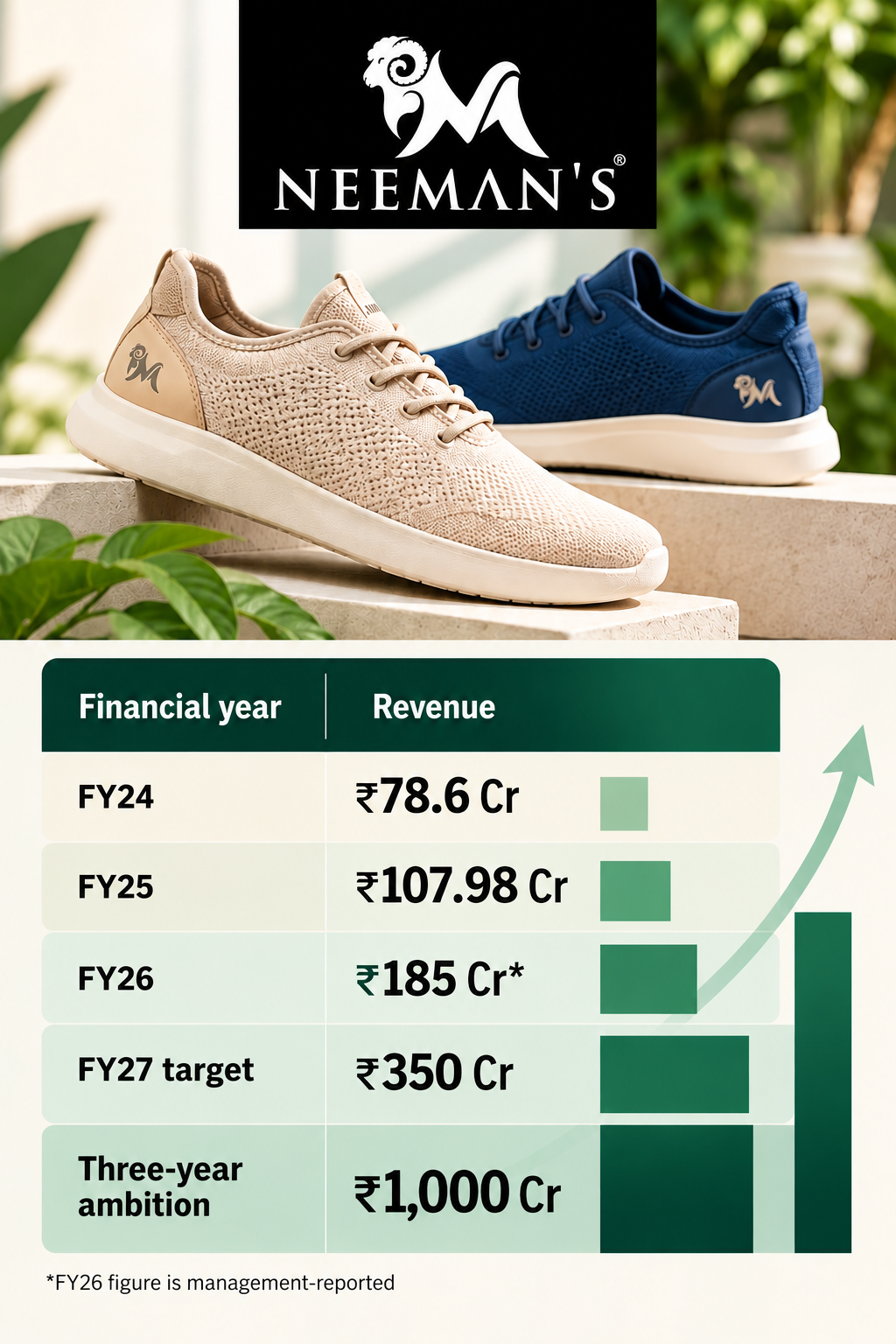 The financial numbers underline how quickly Neeman’s wants to move. Its statutory financial information records Rs 107.98 crore of revenue in FY25, compared with ₹78.6 crore in FY24. The company reported a net loss of Rs 23.02 crore and an EBITDA loss of Rs 18.57 crore in FY25, reflecting the investment phase of the business. The subsequent Rs 185 crore FY26 revenue figure is management-reported, rather than a filed FY26 result.
Moving from Rs 185 crore to Rs 350 crore would require revenue growth of nearly 89% in FY27. The jump from there to Rs 1,000 crore would demand another significant step-up in scale, making the retail rollout, product expansion and operational discipline equally important.
At Rs 1,000 crore, Neeman’s would be operating at a very different level from its origins as an emerging D2C footwear company. The brand would need to demonstrate not only that its proposition works but that it can be replicated across markets without diluting the identity that made it distinctive.
Building the product engine behind the expansion
That is one reason the company’s strengthening of its product organisation assumes importance. Deepu Virmani has joined Neeman’s as Chief Product Officer, bringing more than 25 years of experience across Reliance Retail, Bata India, Bharti Retail, Reliance Footprint and Mirza International. His responsibilities span product strategy, sourcing, product development, buying and merchandising.
The appointment comes at a time when Neeman’s needs to significantly increase the sophistication of its product engine. A 50-store network can operate with a relatively controlled assortment; 500 stores require a deeper and more frequently refreshed product portfolio, better demand forecasting, stronger merchandise planning and the ability to understand regional preferences.
The product challenge is also closely linked to the brand challenge. More categories mean more opportunities to grow the customer relationship, but they also create the risk of losing focus. Neeman’s therefore has to expand its footwear wardrobe without allowing the comfort proposition to become diluted.
The company’s next stage of growth will consequently be determined as much by what sits inside its stores as by how many stores it opens.
Digital heritage becomes an advantage offline
Neeman’s is taking another asset from its D2C past into its physical expansion: consumer data. Its online business has given the company visibility into where consumers are discovering the brand, what products attract attention and which markets demonstrate demand. That information can be used to inform store-location decisions and merchandise planning.
The relationship between digital and physical retail is consequently becoming more circular. Digital helps create discovery and identify demand; the store provides trial and experience; the product experience can then drive repeat purchase across channels.
For a comfort-led footwear brand, that interaction can be especially valuable. A customer who discovers a pair online may still want to experience the shoe physically before buying. Conversely, someone who walks into a store and discovers the brand can subsequently return through the website for another purchase.
This is less a choice between D2C and retail than an attempt to build a genuine omnichannel footwear business.
The economics behind 450 more stores
The distance between 50 stores and 500 stores, however, is enormous. Neeman’s has another 450 outlets to build, and each one brings additional requirements around inventory, working capital, people, real estate, supply chain and store operations.
The company will also have to manage a much wider variety of consumer behaviour. A product that works exceptionally well in a major metropolitan market may not have the same velocity in a smaller city. The ability to use consumer data while maintaining local market sensitivity will become increasingly important.
Store productivity will matter more than store count. The ultimate test of the 500-store strategy will not be how quickly the company can sign leases or open outlets, but whether the network generates healthy sales, repeat customers and sustainable economics.
That is where the 50-store milestone becomes useful. It provides Neeman’s with an initial physical retail base from which to learn what works across malls, high streets, cities and consumer segments before the network becomes substantially larger.
A milestone built by people, not just stores
Both founders have placed unusual emphasis on the people behind the milestone. Chhabra thanked the Neeman’s team for its “hard work, ownership and belief”, while Singh described the 50 stores as belonging as much to the people who solve problems, serve customers and keep showing up every day as to the founders.
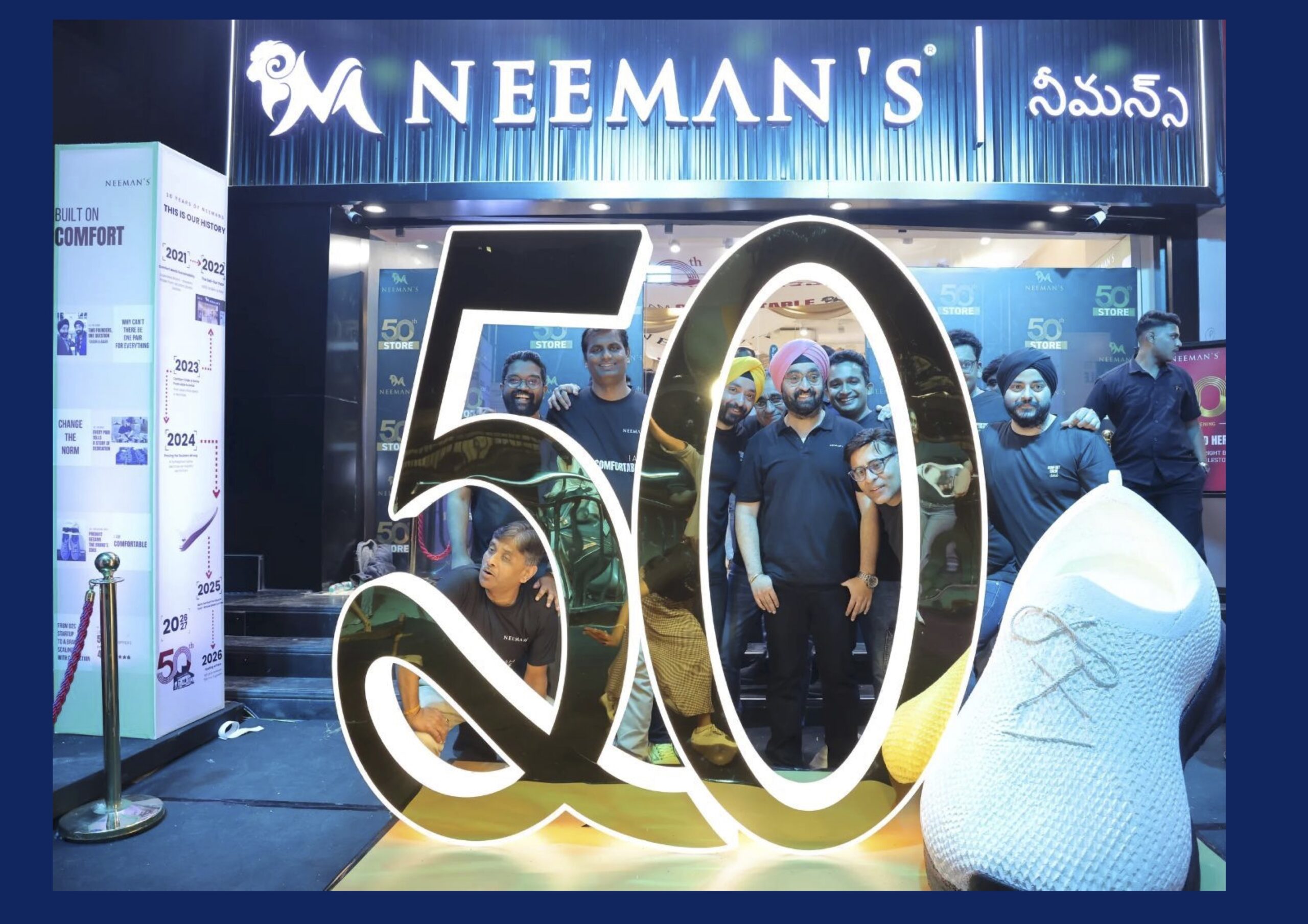
That emphasis is significant because the next phase will require the organisation to scale alongside the brand. A company that grows from 50 to 500 stores cannot remain operationally structured like a 50-store business. Product, merchandising, supply chain, retail operations, technology, people and finance will all need to mature at the same pace.
The founders’ comments also reveal something about the culture Neeman’s is attempting to build. Chhabra’s message to entrepreneurs is rooted in consistency rather than overnight success: “You don’t need to have everything figured out on Day 1. You need the courage to begin, the resilience to navigate the hard days, and the determination to keep getting better.”
For Neeman’s itself, that philosophy now faces its biggest test.
50 down, 450 to go
The 50th store marks the end of one chapter and the beginning of a much larger one. Neeman’s has demonstrated that a comfort-focused Indian footwear proposition can move from digital discovery into organised physical retail, establish a presence across multiple regions and build a network that includes some of the country’s leading malls alongside high streets.
The next objective is considerably more demanding: turning that emerging footprint into a national brand with 500 stores and ₹1,000 crore in revenue.
Chhabra calls the ambition a “big dream” and adds, “that’s exactly how it should be.” Singh offers an equally revealing measure of success: “50 stores is a milestone. The real ambition is to build something that lasts.”
That may ultimately be the more important story behind Neeman’s 50-store milestone. The company is no longer only proving that consumers will buy its footwear. It is now trying to prove that comfort can become a lasting brand proposition—and that an Indian footwear brand built around it can travel from one store to 500.