



For generations, Indian women applied besan and masoor dal to their faces before a bath, not as a beauty ritual, but as a common sense passed down through families. Then came synthetic surfactants, and the daal quietly disappeared from the bathroom shelf.
Delhi-based Ayurvedic personal care brand Nat Habit has spent two years in R&D to bring it back. On National Innovation Day 2026, the brand announced LentiClear™, a proprietary lentil-based cleansing technology, marking the company’s first granted Indian patent.
The Problem It’s Solving
 India’s face wash market is estimated at Rs 10,000–12,000 crore in 2026 and is dominated almost entirely by synthetic surfactant-based cleansers. Natural alternatives have long struggled to match synthetic products on foam, cleansing efficiency, and skin feel, forcing consumers to choose between the two.
The technical barrier was specific. Lentil actives are potent but unstable inside conventional cleansing architectures. Nat Habit spent two years on extraction optimization, compatibility testing, and stabilisation before arriving at a system that could deliver consistent foaming, gentle exfoliation and skin barrier strengthening without sulphates, parabens, or silicones. All formulations are cold-processed.
Gaurav Agarwal and Komal Sharma, the inventors of LentiClear™, said, “Conventional cleansing systems don’t easily accommodate them, which is why this hadn’t been solved at scale before. We spent two years perfecting the formulation science and getting them to work together without compromising on efficacy or experience.”
Why Two Years
In a D2C market where brands routinely launch products within months of spotting a trend, a two-year formulation project requires explanation. Nat Habit’s answer is its vertically integrated structure. The brand develops, tests, and manufactures its formulations in-house, keeping R&D, production, and consumer feedback in close proximity.
CEO & Co-Founder of Nat Habit, Swagatika Das frames it as a deliberate trade-off against speed. “It requires long-term commitment to science, not just speed to market. Our vertically integrated model allows R&D, production, and consumer feedback to work in real time. This significantly reduces iteration cycles and enables deeper problem-solving. In outsourced models, innovation is often limited by external dependencies.”
“The shift is from ingredient awareness to performance accountability. This evolution is pushing brands to move beyond storytelling and invest in deeper formulation science and R&D to deliver outcomes that match or exceed synthetic benchmarks.”
Early Numbers
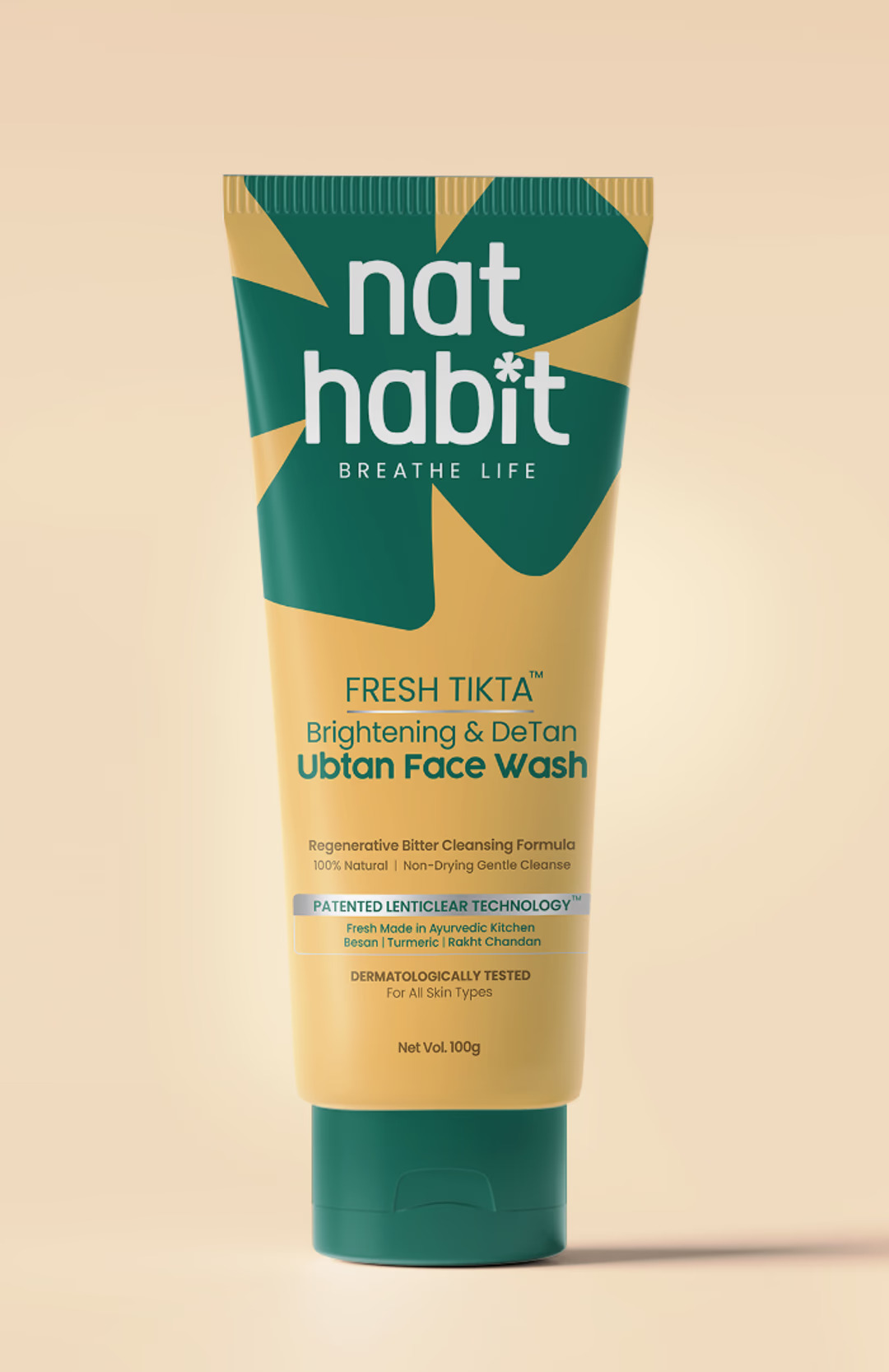
LentiClear™ is currently deployed across three products in Nat Habit’s Tikta face wash range: Ubtan Tikta Face Wash, Masoor Daal Tikta Face Wash, and Kaali Mitti Tikta Men’s Face Wash — all formulated for sun-exposed, pigmented, and pollution-affected skin.
The three products together contribute 87% of the brand’s face wash category revenue. The average repeat purchase rate across the range sits at approximately 52% — a meaningful signal in a category where consumers get immediate daily feedback and switching costs are low.
IP as Strategy
LentiClear™ is the first in what the company describes as a deliberate IP pipeline. Two further proprietary technologies including Beracyl™ for anti-dandruff and Berbamyrisin™ for anti-acne are currently under patent filing. The company has not disclosed the specific claims covered by the LentiClear™ patent, including whether it protects the extraction method, formulation architecture, or both.
Proprietary R&D and IP-building have historically been the territory of large FMCG companies. Nat Habit, founded in 2019 and backed by Bertelsmann India Investments, Fireside Ventures, Peak XV Partners, Amazon India Fund, Mirabilis Investment Trust, and Sharrp Ventures, is positioning this capability as a structural differentiator at D2C scale. The brand currently serves over 45 lakh consumers across more than 10,000 retail touchpoints.
What’s Next
Nat Habit is targeting an ARR of approximately Rs 500 crore over the next 18 months, more than double its current scale. New channels including offline retail, general trade, and quick commerce are expected to contribute 15–20% of total revenues.
Swagatika concludes, “Our growth roadmap is anchored in three parallel priorities: scaling the business, scaling our IP, and scaling responsibly. Growth cannot come at the cost of formulation integrity or manufacturing standards. That discipline will continue to guide every decision we make.”